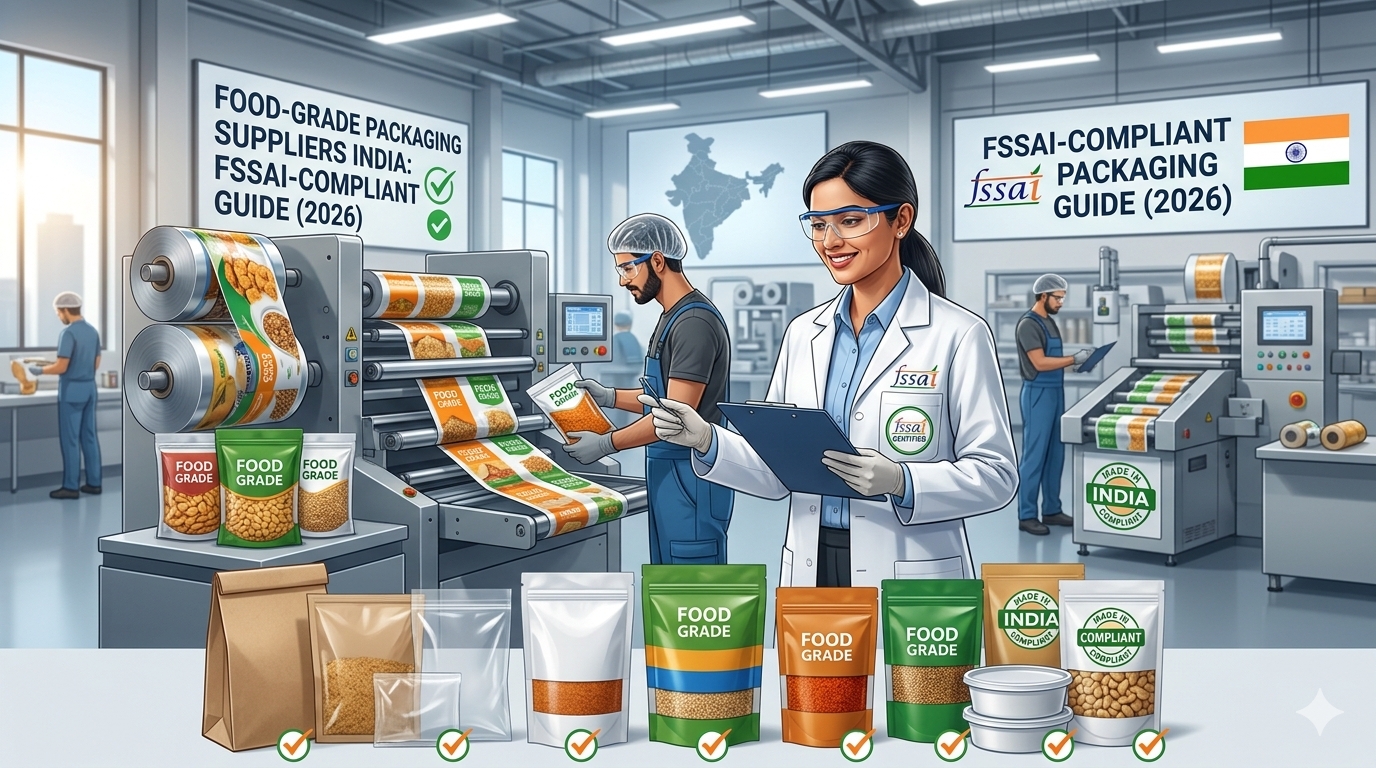
Food-grade packaging in India must comply with FSSAI regulations, meet specific material standards (FCM), and carry proper labeling. This guide lists verified suppliers across India, breaks down material types, and gives you a compliance checklist to avoid regulatory penalties.
FSSAI Compliance: What Every Buyer Must Know
The Food Safety and Standards Authority of India (FSSAI) regulates all food packaging under the Food Safety and Standards (Packaging) Regulations, 2018.
Key requirements:
- Material approval — Packaging must use FSSAI-approved Food Contact Materials (FCM)
- Migration limits — No harmful substances can leach into food
- Labeling — Must include FSSAI license number, batch, date, and nutritional info
- Manufacturer registration — Packaging supplier should have FSSAI license for food-grade production
Non-compliance penalties: ₹2 lakh to ₹10 lakh fine, plus product recall costs.
Types of Food-Grade Packaging Materials
Primary Packaging (Direct Contact)
MaterialUse CaseCost IndexPET bottlesLiquids, oils₹8–25/unitHDPE containersDairy, snacks₹5–20/unitPP containersReady-to-eat meals₹4–15/unitLaminated pouchesSnacks, spices₹1.50–8/unitGlass jarsJams, pickles₹15–60/unitAluminum foilDry snacks₹0.80–3/unit
Secondary Packaging
MaterialUse CaseCost IndexCorrugated boxes (FSSAI-grade)Transport₹12–35/boxPrinted cartonsRetail SKUs₹3–12/cartonShrink filmBundling₹140–180/kgPaper bagsBakery, dry goods₹2–8/bag
Top Food-Grade Packaging Clusters in India
Mumbai-Pune
Strong in PET, HDPE, and laminated films. Home to 200+ FSSAI-registered packaging units.
Ahmedabad-Rajkot
Specializes in flexible packaging (pouches, films). Lower pricing than Mumbai.
Delhi-NCR
Strong in paper-based packaging (cartons, corrugated). Higher quality printing options.
Coimbatore-Tirupur
Specializes in food-grade containers for dairy and bakery.
Bengaluru-Chennai
Growing cluster for premium and organic food packaging.
How to Verify a Food-Grade Packaging Supplier
Use this 5-point checklist:
- ✅ FSSAI License Number — verify on FSSAI's website
- ✅ Food Contact Material (FCM) Certificate — from a NABL-accredited lab
- ✅ ISO 22000 Certification — food safety management
- ✅ Migration Test Reports — for the specific material
- ✅ Client References — other food brands they serve
Red flag: If a supplier can't produce an FCM certificate, they're not food-grade.
Bulk Pricing Benchmarks (Q4 2026)
ProductMOQPrice at MOQPrice at 5x MOQPET bottle 500ml5,000₹6.50₹5.20Laminated pouch 100g10,000₹2.80₹2.10HDPE jar 1kg2,000₹22₹17Food-grade corrugated box500₹22₹15Printed carton (FSSAI)5,000₹6₹4.20
Labeling Requirements for Food Packaging
Every food package must display:
- FSSAI logo with license number
- Product name in English and local language
- Net quantity in standard units
- Ingredients in descending order by weight
- Nutritional information per 100g/100ml
- Batch number and date of manufacture
- Best before / expiry date
- Storage instructions
- Manufacturer name and address
- Customer care details
Non-compliant labels trigger product recall.
Frequently Asked Questions
Q: What's the cheapest FSSAI-compliant packaging option?
Laminated pouches start at ₹2.10/unit in bulk. For dry snacks, this is the most cost-effective primary packaging.
Q: Can I use regular corrugated boxes for food transport?
No. Food transport requires FSSAI-grade corrugated boxes with food-safe adhesives. Regular boxes may have ink or adhesive migration issues.
Q: How long does FSSAI approval take for a new packaging material?
For standard materials (PET, HDPE, PP), no separate approval is needed — just FSSAI-registered manufacturing. Custom or novel materials require approval (3–6 months).
Q: What's the difference between food-grade and food-safe packaging?
"Food-grade" means the material is approved for food contact. "Food-safe" is a broader term — it means the packaging doesn't harm the food. All food-grade is food-safe, but not all food-safe is food-grade.
Q: How do I switch packaging suppliers without FSSAI disruption?
Verify the new supplier's FSSAI license and FCM certificates before switching. Keep 30 days of buffer stock to avoid production gaps.